Olivia Hughes · 4 October 2026
Strategies for Leveraging Metadata Tagging to Boost Search Accuracy in Digital Note Ecosystems
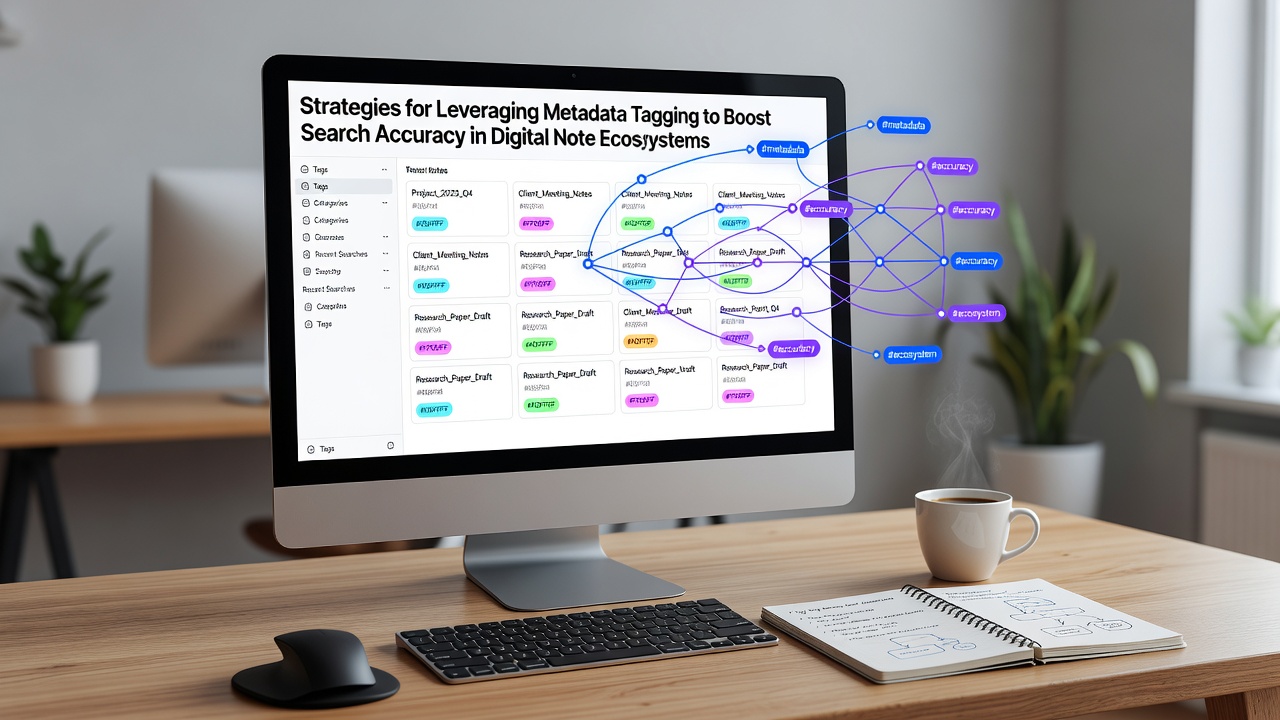
Digital note ecosystems have expanded rapidly as professionals and researchers rely on interconnected platforms to manage growing volumes of information, and metadata tagging serves as a foundational mechanism for refining search precision within these systems. Observers note that structured tags allow queries to surface relevant content even when keywords vary across documents, while standardized fields reduce noise from ambiguous terms that appear in free-text searches alone.
Core Components of Metadata Tagging Systems
Metadata tagging begins with defining categories that capture context beyond simple keywords, including creation dates, project associations, source types, and priority levels, yet effective implementations extend further by incorporating relational links between notes. Researchers at institutions studying information retrieval have documented how consistent application of these fields enables algorithms to rank results based on semantic proximity rather than exact matches, and platforms that enforce tag validation at entry points demonstrate measurable gains in recall rates over time.
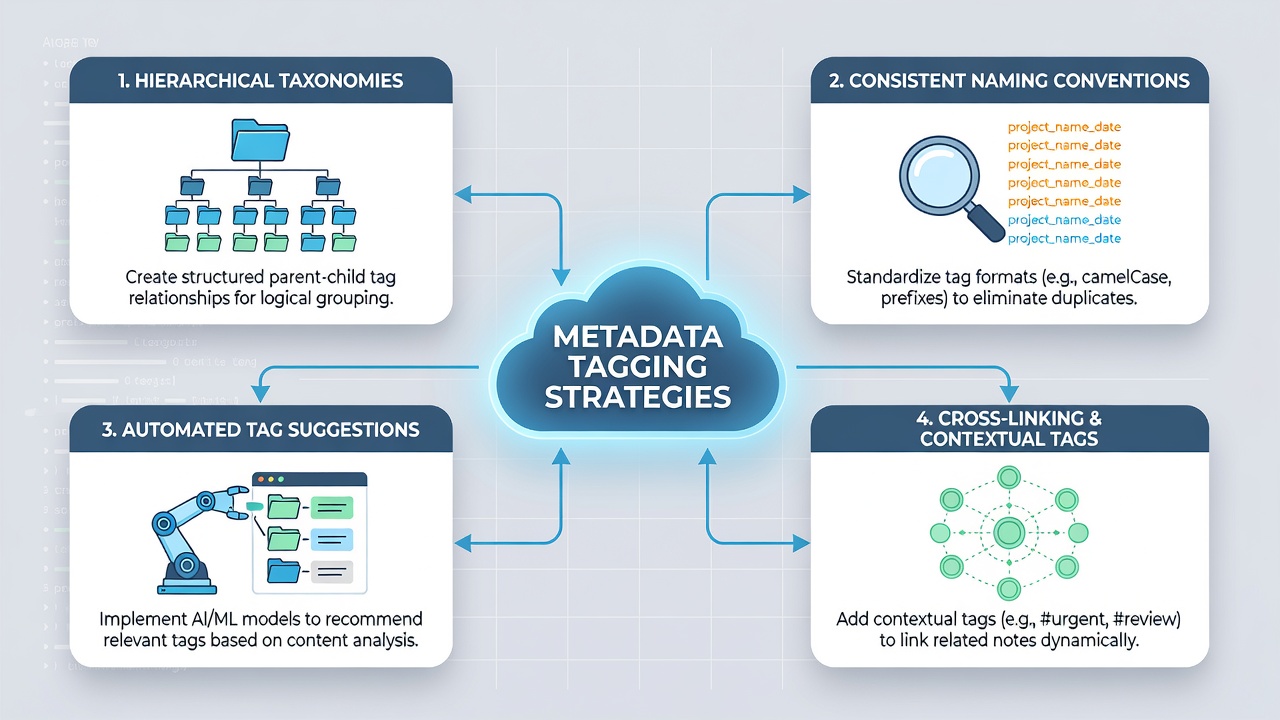
Hierarchical structures prove particularly useful because they permit broad categories to nest narrower descriptors, allowing users to drill down during searches without constructing complex Boolean strings. Data from industry reports indicate that teams adopting such taxonomies experience fewer missed documents when querying large repositories, since the system can infer connections through parent-child relationships and surface related items automatically.
Implementation Approaches Observed Across Platforms
One established method involves integrating automated suggestion engines that analyze existing tags and propose additions during note creation, while another focuses on periodic audits where administrators review tag usage patterns to consolidate duplicates or retire outdated terms. Studies conducted by academic groups in North America have shown that combining these tactics yields higher accuracy scores, especially when platforms allow bulk updates to propagate changes across linked notes without manual intervention on each file.
Training modules embedded within note applications help users apply tags uniformly, and organizations that track adoption metrics report steadier improvements in search outcomes compared with those relying solely on voluntary compliance. In October 2026 several major platforms introduced dashboard visualizations that highlight tag distribution across teams, giving administrators concrete data to guide refinements and maintain alignment with evolving project needs.
Integration with Emerging Technologies
Artificial intelligence models now assist in generating initial tag sets by processing note content and suggesting descriptors drawn from established vocabularies, yet human oversight remains essential to correct contextual errors that algorithms occasionally introduce. Evidence from collaborative projects between universities and software developers indicates that hybrid workflows, where AI proposes and users confirm, accelerate tagging consistency across large datasets while preserving accuracy.
Cross-platform compatibility also receives attention because many professionals export notes between tools, and standardized metadata schemas such as those promoted by international standards bodies facilitate seamless transfer without loss of search utility. A report issued by the International Organization for Standardization outlines recommended practices for maintaining tag integrity during migrations, and implementers who follow these guidelines observe sustained retrieval performance even after system changes.
Measurement of Search Accuracy Gains
Quantitative assessments typically track precision and recall before and after tagging initiatives, with figures revealing that well-structured systems can increase relevant result percentages by double-digit margins in controlled tests. Teams monitoring these indicators over multiple quarters identify patterns where certain tag combinations correlate with faster task completion, prompting further refinement of the underlying taxonomy.
Case examples from research labs illustrate how custom tag sets tailored to specific domains, such as chemistry or legal documentation, outperform generic options because they capture discipline-specific relationships that generic search engines overlook. Observers tracking adoption trends note that organizations investing in these domain adaptations record the most consistent accuracy improvements across user groups with differing expertise levels.
Conclusion
Metadata tagging strategies continue to evolve alongside digital note platforms, and those who apply hierarchical structures, automated assistance, and regular measurement position their ecosystems for stronger search performance. As new features roll out in late 2026, ongoing attention to tag governance and cross-tool compatibility supports sustained gains in retrieval accuracy across varied professional environments.